
Lumbar Spine
Experience the ONLY guided motion imaging available in Oklahoma (with new locations coming soon)!
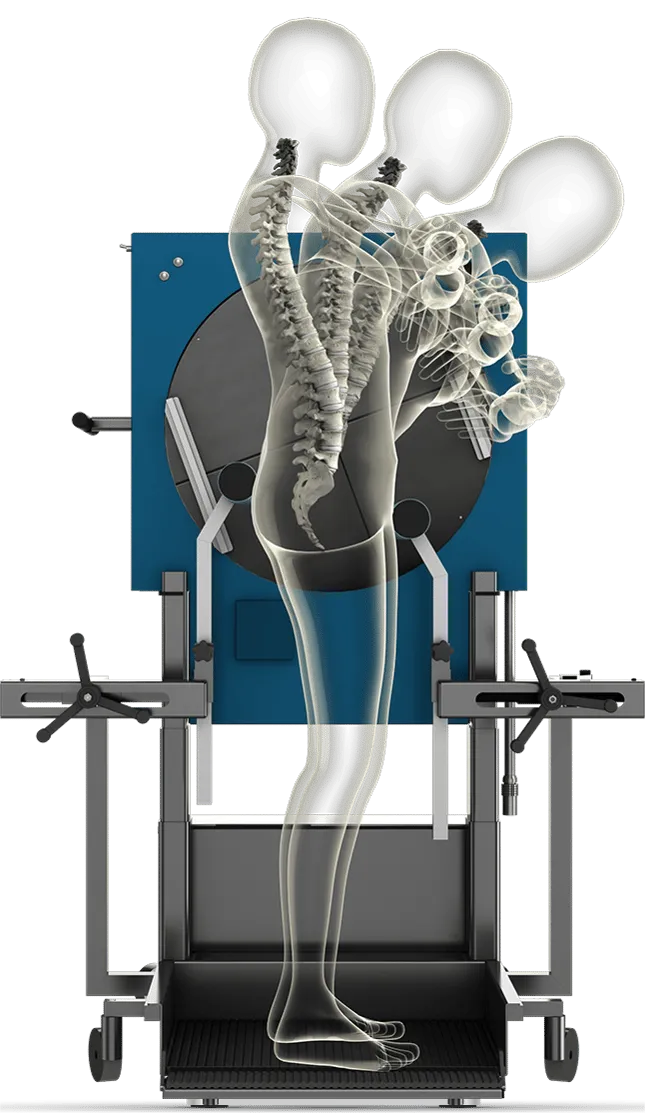
See what is happening in your lumbar spine in real-time… not with an outdated, static x-ray with Guided Motion Imaging.
What Is It?
Conventional imaging methods like static X-rays, MRI, and CT scans capture the lumbar spine at rest. While this identifies structural issues, it cannot detect how the vertebrae interact and instability during movement. Guided motion imaging (e.g., digital fluoroscopy, dynamic X-rays, radiographic motion analysis) captures the spine as it flexes, extends, and moves in real-time.
How Does Lumbar Spine Guided Motion Imaging Work?
As you stand or sit in an upright position, the machine slowly guides you through the appropriate motions, taking video in real-time. Using a proprietary software system, physicians then analyze the data to check for instability, misalignment, and abnormal vertebral motion.
They can also see ligament laxity. This is how loose or flexible your tissue bands are that connect bones at the joints. If they are too loose or flexible, this can lead to joint mobility, instability and more issues.
Why Is This Important?
If your medical professional doesn’t see a symptom via a traditional Xray or scan, they can’t give you the right treatment to heal.
Guided motion imaging provides high accuracy and reliability (PubMed) in detecting instability, (PMC) helps clinicians pinpoint instability (PubMed+1) , determine the need for surgery, target the appropriate physical therapy strategies and monitor post-op recovery based on real data and not assumptions.
The Research Proves Results!

- Detection of Segmental Instability
In a study comparing dynamic X-rays with surgical findings for lumbar stenosis or spondylolisthesis, dynamic radiography achieved impressive metrics—sensitivity: 84.8%, specificity: 100%, and overall accuracy: 90.4%—surpassing traditional clinical exams. PMC
- Quantifying Kinematic Changes in Low Back Pain
Using high-speed digital videofluoroscopy, researchers detected significantly greater intersegmental translation and angular displacement at L5–S1 in patients with chronic low back pain versus healthy controls (p < 0.05)—highlighting movement abnormalities invisible on static images. PubMed
- Real-Time Dynamic MRI Accuracy
Advanced dynamic MRI sequences achieved ≥ 90.5% accuracy in detecting lumbar spondylolisthesis during flexion–extension, with inter-reader reliability (κ) as high as 0.94 for lumbar assessments. PubMed
- 3D Kinematic Mapping in Functional Tasks
In vivo studies using dynamic stereo X-rays captured true 3D motion of lumbar vertebrae during lifting—revealing segmental translations (~5 mm) across L2–S1 and nonlinear movement behavior, particularly at L5–S1. This enriches biomechanical models and aids in improving spinal implant design. PubMedASME Digital Collection
What Did Your Lumbar Spine Scan Miss?
If you still have chronic lower back pain after numerous tests and procedures, did your medical professionals miss something with traditional scans?
Have you been misdiagnosed?
It’s time to use state-of-the-art technology combined with traditional pathways to see what’s going on with your lumbar spine.
Xrays show structural and soft tissue detail for bones, discs, tumors, and nerves. Then, motion guided imaging picks up the gap from here with live movement of the spine to detect lumbar instability and ligament issues.
If you have chronic back pain, schedule your appointment today. You’ll have clarity about your injuries, avoid a misdiagnosis and start to heal!
Brain
- qEEG + ERP
- Baseline Cognitive + Stress Analysis
- Progress Cognitive + Stress Analysis
- Brain Fitness Sessions
Brain + Spine
- Cervical Guided Motion Imaging Scan
- Lumbar Guided Motion Imaging Scan
- qEEG + ERP
- Baseline Cognitive + Stress Analysis
- Progress Cognitive + Stress Analysis
- Brain Fitness Sessions
Spine
- Cervical Guided Motion Imaging Scan
- Lumbar Guided Motion Imaging Scan