
Cervical Spine
Take advantage of the ONLY guided motion imaging in the state of Oklahoma (with more states coming soon)!
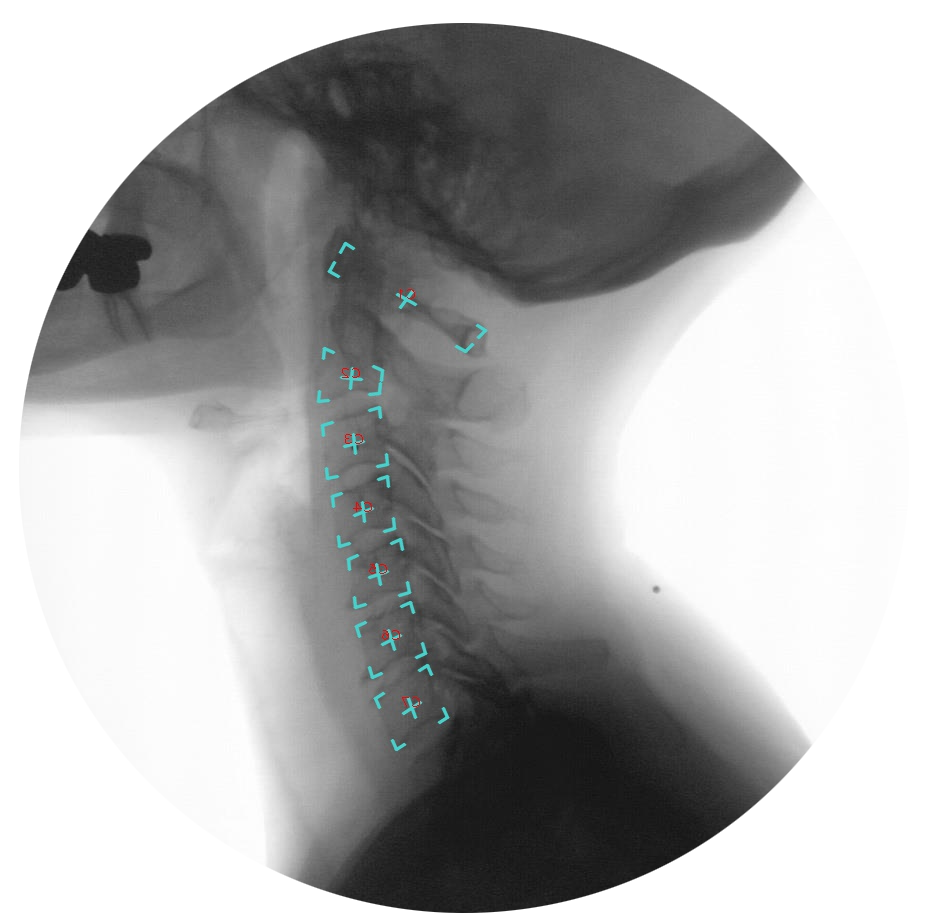
See what your spine is doing real-time… not with an outdated, static x-ray.
This scan provides real-time guided motion imaging in the upper spine and neck, offering valuable insights into spinal function and mobility.
What Is Guided Motion Imaging?
Unlike traditional X-rays, MRI and CT scans that only provide a snapshot of the spine in a fixed position, digital motion X-ray (DMX), or videofluoroscopy, produces a video of the neck with less radiation. This way, you can see how your discs, bones and ligaments go through a full range of motion in real time.
How Does Cervical Spine Guided Motion Imaging Work?
You simply stand or sit in an upright position in a large, open machine, and it slowly guides you through the appropriate motions, taking video in real-time. Using a proprietary software system, physicians then analyze the data to check for instability, misalignment, and abnormal vertebral motion.
They can also see ligament laxity. This is how loose or flexible your tissue bands are that connect bones at the joints. If they are too loose or flexible, this can lead to joint mobility, instability and more issues.
Why Is This Important?
If your medical professional doesn’t see a symptom via a traditional Xray or scan, they can’t give you the right treatment to heal. This means you avoid losing time working or doing the things you love, with the people you love, because you heal faster and avoid pain… now and in the future.
Guided motion imaging reveals issues previously missed by outdated scanning processes so you can get the right treatment plan for your real injury!
The Research Doesn’t Lie!

-
“A study of 196 individuals (119 with chronic neck pain post-whiplash, 77 healthy controls) found that videofluoroscopy detected vertebral instability with 93% sensitivity and 79% specificity, achieving an ROC of 0.88 when at least two abnormal motion findings were identified. Positive predictive value (PPV) and negative predictive value (NPV) both reached 88%. Cases with four or more abnormal findings returned a PPV of 100%.” PubMed
-
Video fluoroscopy also offers objective proof of injury in situations where soft-tissue damage (like ligament tears) isn’t visible on MRI or static radiographs—making it especially valuable in medico-legal and chronic pain contexts.”
Trial GuidesResearchGate
-
“High Diagnostic Accuracy: Up to 93% sensitivity and 79% specificity for instability detection.” PubMed
What Did Your Cervical Spine Scan Miss?
If you are in pain after numerous tests and procedures, did your medical professionals miss something with traditional scans?
Have you been misdiagnosed?
It’s time to use state-of-the-art technology combined with traditional pathways to see what’s going on with your cervical spine.
Xrays show structural and soft tissue detail for discs, nerve damage, herniations, fractures, and tumors. Then, motion guided imaging picks up the missing gap with live movement of the cervical spine to detect instability and ligament issues.
If you have chronic pain, injuries from an accident or misdiagnosed issues, it’s time to get the truth and heal!
Brain
- qEEG + ERP
- Baseline Cognitive + Stress Analysis
- Progress Cognitive + Stress Analysis
- Brain Fitness Sessions
Brain + Spine
- Cervical Guided Motion Imaging Scan
- Lumbar Guided Motion Imaging Scan
- qEEG + ERP
- Baseline Cognitive + Stress Analysis
- Progress Cognitive + Stress Analysis
- Brain Fitness Sessions
Spine
- Cervical Guided Motion Imaging Scan
- Lumbar Guided Motion Imaging Scan